Alexander S. Kolker
In August of 2023, Louisiana broke ground on one of the largest environmental restoration projects in history, which will divert the Mississippi River toward the Barataria Basin and use the sediments the river carries to build wetlands. The project’s groundbreaking was the culmination of decades of work in Louisiana’s coastal community. It also shows how academia, government and the private sector can work together to address a persistent problem — Louisiana’s nearly 2,000 square miles of wetland loss. But the groundbreaking’s location also reveals something deeper: Why it is so important — and so difficult — to address climate change today.
The idea that diverting the Mississippi River would be an effective strategy to reverse Louisiana’s massive wetland loss dates to the 1970s and the work of the scientist Woody Gagliano. Gagliano knew that wetlands in south Louisiana were built from sediment-rich water in the Mississippi River and that levees along the river had reduced that input. Reintroducing the river to coastal wetlands, Gagliano and others reasoned, would be a sustainable way to rebuild Louisiana’s coastal wetlands, nearly 2,000 square miles of which have now been converted to open water.
The Mid-Barataria Diversion project utilizes this concept. With a flow that is nearly three times the size of the Hudson River and a cost of $2.9 billion, it may be the largest and most expensive environmental project in U.S. history. It has also been a part of Louisiana’s Coastal Master Plan since 2012. That plan uses a suite of computer models, calibrated by decades of data, and informed by sea level projections, to identify the projects that build or maintain the most land and reduce the most flooding impacts.
While the groundbreaking’s location near cow pastures and farm fields might seem rural and remote, a closer look reveals vast wealth and vast complexities. About 5 miles down the road from the groundbreaking is a project with a dollar value nearly 10 times greater than the Mid-Barataria Diversion. Venture Global LNG is building a gas-exporting terminal valued at nearly $21 billion, with a $13.7 billion initial phase under construction and a $7 billion extension announced. According to the company’s website, the plant will be powered by two 720-megawatt gas-fired turbines — a combined capacity that is about 25% greater than the nuclear power plant 60 miles upriver. Similar gas-exporting plants emit about 5 million tons of greenhouse gasses annually, a number that does not include the warming impact from the nearly 20 million metric tons of natural gas this plant can export.
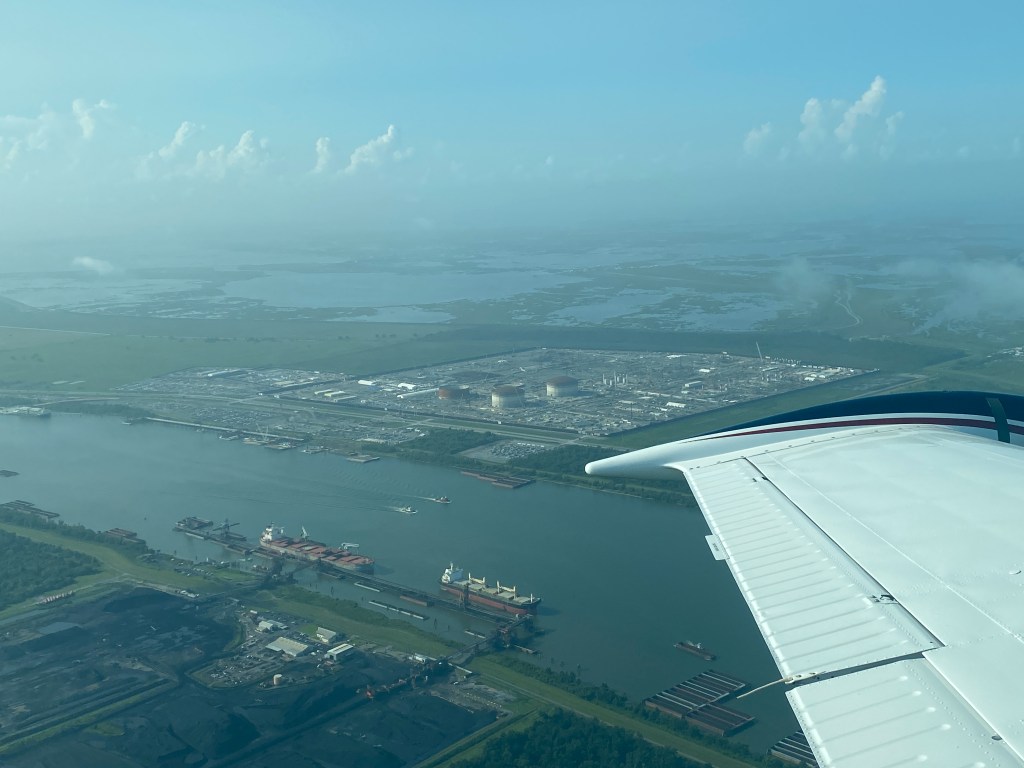
Yet, climate change is a concern here. In 2021, Hurricane Ida passed through this area, bringing hurricane-force winds to many parts of southeast Louisiana. In Grand Isle, about 30 miles south of the groundbreaking’s location, Ida’s winds reached nearly 150 miles per hour. The storm flooded Ironton, a small historically Black community, with 10 to 15 feet of water. The predominantly white and wealthier community on Hermitage Road — about 7 miles away — was struck too, and many homes were flooded, damaged or destroyed. The nearby Alliance Refinery also flooded, and a proposed sale initially valued at $500 million was canceled.
Climate change and its accelerating sea-level rise make projects like the Mid-Barataria more difficult. Louisiana’s 2012 Master Plan, which incorporated the best estimates of sea-level rise at the time, presented a restoration pathway that put the state on a path toward net-land gain in 50 years. The most recent plan, which was approved this spring, shows no pathway for net-land gain, although it can reduce land loss and storm damage to property.
The river, too, has its own plans for the region. About 35 miles downriver from the Mid-Barataria is Neptune Pass, the largest offshoot of the Mississippi River to form in nearly a century. A few years ago, a small access canal expanded rapidly, and a channel that was about 100 feet wide and 15 feet deep is now 600 feet wide and up to 100 feet deep. The system can carry between 100,000 and 140,000 cubic feet of water every second, approaching the size of America’s 10th largest river, the Missouri.
Neptune Pass is building land in a fashion similar to Woody Gagliano’s vision. About a dozen fan-shaped landforms, some hundreds of acres in size, have formed. When waters are low, these lands stick out of the water. All told, 1,000 to 2,000 acres of shallow and partially-emergent lands have formed — at a cost much less than the Mid-Barataria. However, there are concerns that removing large amounts of water from the Mississippi River could impact navigation.

It would be easy to ignore everything here and say that it’s too complicated or too localized. But Louisiana’s waters have never just been about Louisiana. The Mississippi River is the country’s largest pathway, by weight, for waterborne commerce. Louisiana’s coastal zone supports some of the country’s largest fisheries, the northern Gulf Coast — including Louisiana and its neighbors — is home to millions of people and the landscape is stunningly beautiful.
Managing this area is challenging, but science helps provide options. Louisiana’s Coastal Master Plan, for example, screens hundreds of projects and selects those that build the most land (in acres) and reduce the most flood damage (in dollars) over a 50-year period. The U.S. Army Corps of Engineers, which manages the river, uses complex computer models to simulate the impacts of various flood control and river management projects.
But climate change makes everything more challenging, it intensifies land loss, heightens flood risks and amplifies wind damage. There are things governments and the private sector can do, like adding even more sediment to coastal wetlands or building larger levees, but these options are expensive. With nearly half the global population residing near the sea, and coastal flooding on the rise worldwide, the lessons from Louisiana’s coastal challenges resonate on a global scale.
Climate change is making our coasts more dangerous, but our coasts are too valuable to walk away from. Addressing the root causes of climate change may sometimes seem daunting, but this stretch of Louisiana’s coast shows why it is so important.
An earlier version of this piece appeared on The Messenger in August, 2023.
 ALEX KOLKER, PhD
Leave a comment